Friday, October 2, 2009
Consumption Issues
Men Cry Too
This particular episode was interesting because in class, we've talked about the different roles that are portrayed by men and women in telenovelas. However, this scene did not fit the script. Dylan, the son of a seemingly happy couple, finds his father, Federico, outside crying right before he and his wife are to go to Miami for a vacation. In this couple, both the husband and wife are working, however, the wife, Frida, takes her work much more seriously. When Dylan asks his father what is wrong, his father explains to him that things are not going well between him and Dylan's mother. The father feels that the mother values her job over their marriage and that he suspects that there may be someone else. This is a totally untypical view of the male's role in the relationship. So far, I had seen nothing but men who either felt nothing about the women they were with, or men who were portrayed as the leader of the household. I feel that most of the time, the woman is the one that is fretting over the future of the relationship. However, I like how the show portrays the other side of the coin. Although women may cry more, it's nice to know that men cry too.
Powerful Influences
A Less Controversial Love Triangle


"Of Mice and Men" as a Telenovela?
We're Addicts!
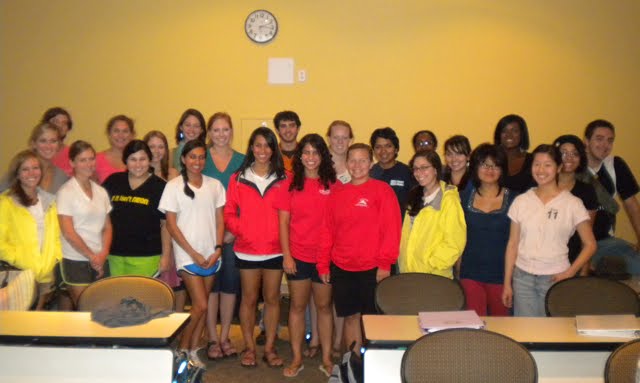
Take this Telenovelas class, for instance. A large majority of us had never seen telenovelas before. In addition, I think it is safe to say we had stereotypical telenovela ideas in our minds. We get into this class, learn about telenovelas, watch one on our own, and boom! We're addicted. When I went home to Atlanta one weekend, I only brought discs 1 and 2 (out of 4) with me. What a mistake! I finished the first two so quickly and couldn't wait to get back to Athens and finish the rest.
As I have mentioned before in an earlier post, I love TV. I can watch marathons like a pro! I don't know what it is about TV shows and series that keep us wanting more. But I feel like having a commitment to a specific show is comforting. Similarly, a person with an addiction to smoking cigarettes probably feels better after a smoke break.
I love listening to everyone in class talk about "their" telenovelas. It's so great and amusing to see the impact this class has had. One person even has a telenovela DVD set on her Christmas wish list. So at least our parents are probably much happier knowing our drug of choice is telenovelas.
My Issues with Consumption
There are several aspects of consumption that intrigue me. For example, it’s extremely hard for me to wrap my head around the thought of a man watching a telenovela everyday and being just as consumed and wrapped up in it as women are. In the States, men who watch soap operas are thought to either be homosexual or "in the closet." Simply watching a soap opera makes people view you as less of a man.
Now, I am one of those people who is very against stereotypes. I understand that we all, in some form or fashion, are guilty of stereotyping others but I try very hard to see people for who they are and not who society tells me they are. I think this comes from people stereotyping me so much—people assume that because I’m a black woman that I am loud, from the ghetto (or know someone from the ghetto), and that I like to say things like “What’s up my home skillet,” so I really try to go out of my way to look past stereotypes. I am also an equal rights advocate. I despise the double standards between men and women that exist in our culture, and I know that as a double minority I have to work twice as hard to get half as far as my Caucasian counterparts. I am kind of going on a tangent now but I suppose equality between the sexes could make for another blog topic…
All that being said, for some reason I still have a hard time picturing guys gossiping about the most recent episode of the telenovela they’ve been watching. I know that this is society keeping me from grasping this idea but I’m working on overcoming it. Maybe if I actually spoke with a group of guys and included myself in the conversation then it wouldn’t be so hard for me to picture. All in all I guess that I’m glad that men are free to engage in deep conversation about telenovelas if they want to. Equality between the sexes, whoop whoop!
Something else that I find interesting about the consumption of telenovels is that although everyone has an opinion about what they like and dislike about a telenovela, they still write their thoughts anonymously. Message boards dedicated to dialogue concerning telenovelas rarely display someone’s actual name. If so many people are openly voicing their opinions in everyday conversation, I don’t understand why the need to hide online? The beauty of the internet is that it has the ability to connect people from all over and allows them to communicate according to their interests.
For some people, participating in discussions under a pseudonym may be in their best interest (let’s say for researchers, directors, and actors this would be appropriate) but I do not see the need for the general public to hide their identities as well. Is it because they are afraid of what their governments will do? Or do people simply feel like they can be more candid if they use a pseudonym?
Maybe some of you have thoughts on why so many people hide their identities because I just don’t get it.
Thursday, October 1, 2009
Rubí vs. Bárbara
Even after researching for my consumption presentation and finding Bárbara Mori in her other roles, I still can’t imagine her as anything but evil, and I know that if I watch another telenovela with her in it, I am going to automatically dislike her. These actors assume their roles to such a great extent, it seems impossible that they would be able to shed the character and assume a new, and often completely opposite role; but they do. And this is where I have to express my admiration for actors. It makes me think of what Marisa Román said about the process of assuming new roles: it takes a long time and a lot of preparation, and sometimes she becomes invested in the character so completely that she has to make a conscious effort to separate fiction from reality.
Contemporary Issues
Last Wednesday’s class about the representation of certain contemporary issues really made me realize how a telenovela can connect with the hearts and minds of its audiences. We discussed the issues of domestic abuse, alzheimers disease, and plastic surgery.The issue that really struck in my heart was Peligrina’s story of alzheimers from Ciudad Bendita. One of my grandmothers in the past five years has struggled with her memory. About five years ago, my grandmother started to forget minute things, like how to cook certain dishes she had been preparing for the past fifty or sixty years, or forgetting to turn the stove off , or turn the water in the washer on but forget to add the clothes. My grandfather started to get a little frustrated with her forgetfulness. But, about a year ago my grandmother’s memory really began to fade away. She has trouble remembering and identifying her own husband and children. Maybe she knows the names of people close to her, and she says she remembers after she is told, but the same lack of recollecting occurs about every day.
I can tell that it hurts my grandfather, my mom and her siblings the most. Even as a one of ten grandchildren, it hurts that a grandmother who I only get to see every few years probably does not even know I exist anymore. Peligrina's action of getting a tatoo with the names of her loved ones, was a great idea.
This past summer I wrote a poem thinking of my grandmother.
If one day I may lose my memory
Please still sit and stand by me.
I can’t remember now.
So, if I hurt you , just say “ow”.
The pain I don’t feel,
To those around me it will seem surreal.
The detailed memories all seem so vague
Everyday to me you might say:
Have you me forgotten?
Is your past now rotten?
My words and actions are unintentional
My memories have become alloy and therefore null.
But you are my life and will always be.
Please don’t let my life leave me.
Deep down I do remember
In my heart you will be forever.
The Perfect Imperfection
Advertising creates identity. This does not necessarily mean the actual advertisements in the media, but the way in which they portray our society today. The media has a heavy influence on people’s behaviors and actions, and within the popular culture, meanings are fighting with each other and giving off different vibes and motives.
For many young adults who are still learning about themselves and the world, this could be an extremely frustrating thing. For example, young adults---whether it be from their parents, professors, peers, or the modern culture in general---are offered a wide-range of opportunities. They are taught to “Make good grades. Do everything. Be Involved. Get a top job when you graduate.” While these are all ambitious and encouraging messages, they are also taught to “Be yourself. Have fun. Don’t work too hard.” Clearly, these are contradictory messages. Both pieces of advice are beneficial on their own, but not when they are put together.
Media and advertising are also throwing out clashing messages by showcasing flawless perfect women, while at the same time, warning against the dangers of eating disorders and being obsessed with appearances.
As we wrap up our discussions on representation and identity, I think this concept applies to many of the characters in telenovelas. The more that the characters are influenced by contradictory culture ambitions, the more they become someone they are not. The antagonist in La Mentira, Virginia, goes through this process as she changes from what appears to be a sweet, innocent woman, to an evil vengeful liar. She is influenced by the terrible pressures of the outside world, which ultimately cause her to lose her identity. She goes so far, that eventually her family does not want to associate with her.
The bar for achievement continues to rise for each generation, and so do the hypocritical pressures of the media world. We must be stable with who we are so we are not susceptible to these negative changes.