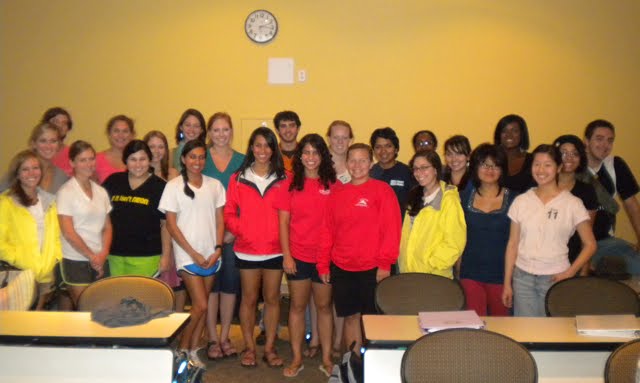
I know it has been almost a week now and I would have posted sooner but I have been so extremely busy! I wanted to dedicate this post to our amazing visit with Marisa Román, the beautiful and humble young actress who surprised our class last Friday. Not only does she have a true talent for acting, but she has the most genuine and passionate outlook on life. I found her so interesting and thought that she raised many relevant points throughout our visit with her. Dr. A described telenovelas as “acting boot camp” because of the strenuous long hours and unexpected script changes that occur while filming. She said that often times the director doesn’t even know what is going to happen next. Therefore, it is the actor’s job to develop their character to how they think they should be perceived. Marisa Román said that it requires a lot out of an actor, which is the precise reason why Padrón continually challenges her with a variety of character types. One of the things that she said that stuck out the most in my mind was how acting and psychology are intertwined. They both explore human nature and require a large amount of inner thought and perception. The more I thought about it, I understood how true this is. This is the reason why telenovela actors have to get so into their characters. Marisa also said, “the more I know myself, the more I enjoy being other people.” I think this is relevant to many things in life, not only acting. It must be difficult for her to keep her characters’ lives and her own personal life separate, but I think she does a good job of this. I think she is able to learn from her characters, while at the same time not getting too wrapped up in the fame and becoming superficial. I think Marisa Román is an extraordinary woman, who knows who she is, even at this young of an age. Her visit, along with my previous knowledge of telenovelas, have made me even more eager to dissect the societal issues in my telenovela.
Thursday, September 17, 2009

Destilando Cinderella
The name of the Mexican telenovela I am watching is "Destilando Amor," and after learning about what makes a telenovela story a cinderella story, there is no doubt in my mind that this is a cinderella story nearly scene for scene... except for one main difference.
In Destilando Amor, the protagonist, called Gaviota, is a rural farm worker, lower class, she is exceptionally beautiful and light-skinned, she is a virgin, good-natured and naive... until she travels and becomes more wise! She goes as far as Paris (where she is hit by a car and loses the baby she is pregnant with, of course) and when she returns to mexico, she and her mother move to the city. She easily adapt to urban life and goes through socioeconomic ascent as she gets jobs and is promoted to manager's assistant in a huge corporation. As long as this storyline will continue to follow Dr. A's predicted cinderella plot line, I expect to soon see a more complete transformation of the protagonist and hopefully a bit of revenge.
Destilando Amor does, however, challenge the typical cinderella story's machismo. You see, the male protagonist is also a virgin at the beginning, and he will only have sex with his true love, Gaviota, even despite being in another marriage (he proclaims "no intimacy" between them) and resisting his wife's continual attempts at seduction. It has been two years wince Gaviota and Rodrigo have been together, and they both remain faithful to each other while apart. Rodrigo's character strongly challenges the hegemony of male sexual freedom.
However, hegemonic machismo still persists, as shown in one scene where Rodrigo's cousin accuses Rodrigo of being gay, an assumption he made because he knows his cousin has not had sex with a woman yet. But when the cousin discovers Gaviota's (lost) pregnancy, he congratulates Rodrigo for his sexual 'success' and finally respects him as a man... because it is sexual conquest that makes a man strong and able, while it is merely expected for the woman to be the source of this ladder-up for the man.
Stay strong, Rodrigo, and wait for the reunion with your true love!
In Destilando Amor, the protagonist, called Gaviota, is a rural farm worker, lower class, she is exceptionally beautiful and light-skinned, she is a virgin, good-natured and naive... until she travels and becomes more wise! She goes as far as Paris (where she is hit by a car and loses the baby she is pregnant with, of course) and when she returns to mexico, she and her mother move to the city. She easily adapt to urban life and goes through socioeconomic ascent as she gets jobs and is promoted to manager's assistant in a huge corporation. As long as this storyline will continue to follow Dr. A's predicted cinderella plot line, I expect to soon see a more complete transformation of the protagonist and hopefully a bit of revenge.
Destilando Amor does, however, challenge the typical cinderella story's machismo. You see, the male protagonist is also a virgin at the beginning, and he will only have sex with his true love, Gaviota, even despite being in another marriage (he proclaims "no intimacy" between them) and resisting his wife's continual attempts at seduction. It has been two years wince Gaviota and Rodrigo have been together, and they both remain faithful to each other while apart. Rodrigo's character strongly challenges the hegemony of male sexual freedom.
However, hegemonic machismo still persists, as shown in one scene where Rodrigo's cousin accuses Rodrigo of being gay, an assumption he made because he knows his cousin has not had sex with a woman yet. But when the cousin discovers Gaviota's (lost) pregnancy, he congratulates Rodrigo for his sexual 'success' and finally respects him as a man... because it is sexual conquest that makes a man strong and able, while it is merely expected for the woman to be the source of this ladder-up for the man.
Stay strong, Rodrigo, and wait for the reunion with your true love!
Wednesday, September 16, 2009
Just a Flow of Thoughts
I am just six episodes in to "Sin Tetas No Hay Paraiso" and it is ridiculously awesome. It is so exciting and drama filled. The main character has already: turned her first trick, escaped murder, been raped, gotten proposed to, become pregnant, had an abortion, gotten someone else killed, broken up with her boyfriend, destroyed her relationship with her mother, and found a sugar daddy. It makes me wonder how the writer could possibly fill up the remainder of the 23 episodes. I am not really clear if this show is abridged or not. I think it must be, it's kind of bizarre. It jumps from one thing quickly to the next. I like it, though. Obviously, this is a telenovela ruptura. I am not really sure where the love scenes come in, there are minor ones with Catalina and her boyfriend (who also has a crush on Catalina's mom!), and Catalina and her customers, but it's all pretty sordid. Unless it is going for the "Pretty Woman" story line, which I doubt, this not a cinderella story at all!
Surprise! She's here!
So I know it's a few days overdue, but I have been extremely busy over the past week or so. But on to Marisa Roman! What an amazing surprise! The experience of getting to actually meet a telenovela star so early on in the class was so unexpected but so awesome! Usually we only get to do interviews via Skype, not in person! First of all, it was great how she made such an effort to talk to us in English. I liked it when she talked in Spanish because I felt like I could see more of her true personality because that is her native tongue. But she was awesome for speaking English as best she could for us-which was pretty good too! I don't think I sound that good when I speak in Spanish. haha. It was so great to hear from her why she loves working in telenovelas and about her life in general. I found it all so interesting! I also thought it was cool that she had been filming in New York and that she went outside of her country for career opportunities. She is very talented and very modest. I can see why everyone loves her so much. This is definitely not something I will forget about-I kept telling all my friends that I met a famous actress. They were like who? and I was like she is famous in Venezuela! My next goal is to get my friends hooked on telenovelas...
Tuesday, September 15, 2009
So many aspects wrapped up in one
Who knew that an extremely famous actress from Venezuela could be so sweet, so down to earth and possess such a strong love for acting that goes much deeper than just the fame. It was such a pleasure to talk with Marisa Roman, and talking with her in person made the experience that much greater.
In America we view Hollywood actors and actresses as almost untouchable. We watch them in every movie they make and read about them in Entertainment Weekly and People magazine, but other than that, we know little about who they really are. It is difficult for me to believe all the outrageous headlines I see on the magazines while standing in line to pay for my groceries. I think this is because the older I get, the more I know that most of them are just attention grabbers to get you to impulse buy. I feel badly for some of the stars who are constantly portrayed in a negative light in the media through magazines, the internet and gossip TV shows. On the one hand, I understand that the negative gossip comes with the title of being famous, but on the other hand I think people get so caught up in all the rumors that they forget that these people are just trying to do their jobs and do them well.
I have enjoyed studying Marisa Roman because through this class, I am able to see her for her exceptional talent as an actress without sifting through any hearsay. It takes a very talented and dedicated person to perform a role in a movie, show or telenovela. It involves a great deal of preparation, research and practice with the character before you really begin to dive into the role. Marisa truly cares about convincing her audience of whatever role she has to play. She said that she actually enjoys becoming different characters so she doesn't have to be herself all the time. She enjoys the challenge of playing different personalities and feels the longer she plays a role the more she learns about the true sense of the character. I thought that it was so interesting to discover that she doesn't watch much of her work for fear of over-critiquing herself. That is how you know you're good; when you believe that there is always room for improvement.
I thought the most impressive topic she touched on was her idea of fame. I wanted to ask her if she was able to roam the streets without getting mobbed. Another student briefly touched on this when they asked how often she was recognized. She said that the amount of people who approach her still never ceases to amaze her. "How could someone be that fascinated with me?" she says. I could tell by her overall demeanor that she was very humble and always kind and generous to her fans. She said that some actors are just out to become famous. They are so caught up in the fame and fortune that they really are not able to grasp the true meaning of entertainment and how it applies to telenovelas.
I could tell that Marisa enjoys acting just for the pure reason of entertaining an audience while spreading a message to her country at the same time. Her favorite writer is a man who writes telenovelas that incorporate important societal and political issues. It really does amaze me that such an incredible actress is truly focused on making her country a better place through her work. It has to be an exciting life, but difficult at the same time with all the hard-work that comes with the job and the fame. Thank you, Marisa, for allowing me the opportunity to discover what it means to truly be a great actress and a great person.
In America we view Hollywood actors and actresses as almost untouchable. We watch them in every movie they make and read about them in Entertainment Weekly and People magazine, but other than that, we know little about who they really are. It is difficult for me to believe all the outrageous headlines I see on the magazines while standing in line to pay for my groceries. I think this is because the older I get, the more I know that most of them are just attention grabbers to get you to impulse buy. I feel badly for some of the stars who are constantly portrayed in a negative light in the media through magazines, the internet and gossip TV shows. On the one hand, I understand that the negative gossip comes with the title of being famous, but on the other hand I think people get so caught up in all the rumors that they forget that these people are just trying to do their jobs and do them well.
I have enjoyed studying Marisa Roman because through this class, I am able to see her for her exceptional talent as an actress without sifting through any hearsay. It takes a very talented and dedicated person to perform a role in a movie, show or telenovela. It involves a great deal of preparation, research and practice with the character before you really begin to dive into the role. Marisa truly cares about convincing her audience of whatever role she has to play. She said that she actually enjoys becoming different characters so she doesn't have to be herself all the time. She enjoys the challenge of playing different personalities and feels the longer she plays a role the more she learns about the true sense of the character. I thought that it was so interesting to discover that she doesn't watch much of her work for fear of over-critiquing herself. That is how you know you're good; when you believe that there is always room for improvement.
I thought the most impressive topic she touched on was her idea of fame. I wanted to ask her if she was able to roam the streets without getting mobbed. Another student briefly touched on this when they asked how often she was recognized. She said that the amount of people who approach her still never ceases to amaze her. "How could someone be that fascinated with me?" she says. I could tell by her overall demeanor that she was very humble and always kind and generous to her fans. She said that some actors are just out to become famous. They are so caught up in the fame and fortune that they really are not able to grasp the true meaning of entertainment and how it applies to telenovelas.
I could tell that Marisa enjoys acting just for the pure reason of entertaining an audience while spreading a message to her country at the same time. Her favorite writer is a man who writes telenovelas that incorporate important societal and political issues. It really does amaze me that such an incredible actress is truly focused on making her country a better place through her work. It has to be an exciting life, but difficult at the same time with all the hard-work that comes with the job and the fame. Thank you, Marisa, for allowing me the opportunity to discover what it means to truly be a great actress and a great person.
Light-skinned actors. Why?
As I am watching my Mexican telenovela, I noticed that the most if not all of the cast is light-skinned. I am pondering over why this is so? I researched the cast of other telenovelas and found the same pattern. For example, the cast of Sin Tetas No Hay Paraiso, Juana la Virgen, and La Vida Entera all have light-skinned actors and actresses. Isn’t this not an accurate representation of the population in Latin America? In Mexico especially, much of the population is comprised of mestizo people, and these people tend to be dark-skinned. I guess the media industry gives the people what they want to see, so these light-skinned actors must be chosen for a reason. Perhaps this topic will be covered in class as we continue to talk about representation and identity..or perhaps you guys have thoughts/opinions?
Europe vs. Latin America
While watching the various clips of the different Bettys, it was very clear that when it comes to standards of beauty, wearing glasses and braces don't make the cut. What was also very clear, was how different the standards of beauty were in Europe versus Latin America and how serious each region took the "lack" of beauty in their characters.
The clips from the Latin American Bettys were colorful and comical, while those from Europe were much more dark and serious. While this may be a testament to how each responds to those who they find less than attractive, I also saw it as clear evidence of how different the cultures of the regions are. I noticed when we were watching the clips from Latin America, there was an emphasis on the look of the character, not just the "nerdiness" of the character. In the clips from Europe, there was more of an emphasis on the actual personality of the character, but no much the outward appearance.
This signaled a few things to me. Number one, that Latin American writers and producers wanted to have fun with the concept of "Ugly Betty" and saw this telenovela as an opportunity to do that. While, beauty is important in Latin America, writers gave Latinos someone they could fall in love with. Their characters seemed more like someone with a quirky personality, but was lovable. On the other hand, the European versions made it seem like European writers had an agenda that they wanted to pursue. European Betty seemed as though her "ugliness" was a disability that needed to be fixed. I didn't see the same quirkiness that I saw in Latina Betty.
Don't get me wrong, I am in no way bashing European styles of telenovelas, but I do feel that they could make Betty a little more... happy. Perhaps the style of programming of each region reflects what is going on in that part of the world. Maybe Latin Americans want to get away from the problems that are going on around them and Betty gives them a way out. Whatever the case, each region is just a reflection of what consumers want... and customers are always right.... Right?
The clips from the Latin American Bettys were colorful and comical, while those from Europe were much more dark and serious. While this may be a testament to how each responds to those who they find less than attractive, I also saw it as clear evidence of how different the cultures of the regions are. I noticed when we were watching the clips from Latin America, there was an emphasis on the look of the character, not just the "nerdiness" of the character. In the clips from Europe, there was more of an emphasis on the actual personality of the character, but no much the outward appearance.
This signaled a few things to me. Number one, that Latin American writers and producers wanted to have fun with the concept of "Ugly Betty" and saw this telenovela as an opportunity to do that. While, beauty is important in Latin America, writers gave Latinos someone they could fall in love with. Their characters seemed more like someone with a quirky personality, but was lovable. On the other hand, the European versions made it seem like European writers had an agenda that they wanted to pursue. European Betty seemed as though her "ugliness" was a disability that needed to be fixed. I didn't see the same quirkiness that I saw in Latina Betty.
Don't get me wrong, I am in no way bashing European styles of telenovelas, but I do feel that they could make Betty a little more... happy. Perhaps the style of programming of each region reflects what is going on in that part of the world. Maybe Latin Americans want to get away from the problems that are going on around them and Betty gives them a way out. Whatever the case, each region is just a reflection of what consumers want... and customers are always right.... Right?
Sunday, September 13, 2009
Creative Criticism & Escapism
Meeting Marisa Román, what a surprise! I particularly enjoyed the specific cultural references she made. The political restraints on writers provides a difficult work environment I’m sure, but it gives way to even more creativity.
Telenovelas provide such a unique outlet for writers because of the limited time in which episodes are conceived and filmed. Unlike American sitcoms or soap operas, novela writers can make political or social commentary in an immediate, practically day-of response to an event. It’s good to know that it has the potential for immediate political and social criticism, even if that’s not its primary use.
Its entertainment function of course is the most important and equally beneficial to society. We would go crazy without some form of escapism or another. Telenovelas are evolving, even though they keep some basic elements, to entertain in new ways and redefine the genre. Between rosas and rupturas it seems they’ve got the hopeful and the realistic aspects of life covered pretty well.
(Somewhat unrelated but speaking of creativity above political influences, you guys may enjoy the movie El espiritú de la colmena. It premiered during Franco’s regime in Spain and has a strong tie to political themes. Dense but quality!)
Telenovelas provide such a unique outlet for writers because of the limited time in which episodes are conceived and filmed. Unlike American sitcoms or soap operas, novela writers can make political or social commentary in an immediate, practically day-of response to an event. It’s good to know that it has the potential for immediate political and social criticism, even if that’s not its primary use.
Its entertainment function of course is the most important and equally beneficial to society. We would go crazy without some form of escapism or another. Telenovelas are evolving, even though they keep some basic elements, to entertain in new ways and redefine the genre. Between rosas and rupturas it seems they’ve got the hopeful and the realistic aspects of life covered pretty well.
(Somewhat unrelated but speaking of creativity above political influences, you guys may enjoy the movie El espiritú de la colmena. It premiered during Franco’s regime in Spain and has a strong tie to political themes. Dense but quality!)
If it aint't broke then don't fix it
What is it about telenovelas that keep people watching week after week? Plots are recycled over and over again in telenovelas but people keep watching. There’s the typical Cinderella story of unlikely love, the Romeo & Juliette story of forbidden love, and the ever-popular twins of different economic statuses switching lives. I can’t help but ask myself with such predictable over the top story lines, why do people continually and devotedly watch telenovelas?
Telenovelas not only recycle plots and story lines but they also recycle whole scripts. Even when telenovelas are remade their audiences are still just as engaged as if they are watching the story for the first time. Sometimes the audience is even oblivious to the fact that they are watching a story that they have seen before. In America, we are always looking for the next big new and ingenious idea, but in the telelnovela world if it’s not what people are accustomed to then it’s not a hit. When writers try to break the mold their new ideas are often unwelcomed by the audience.
The basic components of a successful televonela include a whole heap of drama, good must defeat evil, and above all love must prevail. The plots that people use over and over again contain all of these components making them a sure fire recipe for success. I suppose that telenovelas containing these components are so popular because we live in an age where these ideals are hard to come by. Bad things happen to good people all the time, and with the divorce rate at 50% in the U.S., clearly love does not always prevail. I suppose telenovelas give people comfort because we can depend on them to always come on the same time everyday with the same entertainment that people love, and they give people hope. They give them hope that love is enough to overcome all the odds.
Telenovelas not only recycle plots and story lines but they also recycle whole scripts. Even when telenovelas are remade their audiences are still just as engaged as if they are watching the story for the first time. Sometimes the audience is even oblivious to the fact that they are watching a story that they have seen before. In America, we are always looking for the next big new and ingenious idea, but in the telelnovela world if it’s not what people are accustomed to then it’s not a hit. When writers try to break the mold their new ideas are often unwelcomed by the audience.
The basic components of a successful televonela include a whole heap of drama, good must defeat evil, and above all love must prevail. The plots that people use over and over again contain all of these components making them a sure fire recipe for success. I suppose that telenovelas containing these components are so popular because we live in an age where these ideals are hard to come by. Bad things happen to good people all the time, and with the divorce rate at 50% in the U.S., clearly love does not always prevail. I suppose telenovelas give people comfort because we can depend on them to always come on the same time everyday with the same entertainment that people love, and they give people hope. They give them hope that love is enough to overcome all the odds.
Subscribe to:
Posts (Atom)